INTRODUCTION:
A piece of character design should establish a character's role and place in the story - either as comic relief,, love interest, protagonist or antagonist. This can be communicated through silhouette, posture, facial expression, colour scheme etc. The emphasis on communicating characteristics is what differentiates that character design from costume design.
A piece of character design should establish a character's role and place in the story - either as comic relief,, love interest, protagonist or antagonist. This can be communicated through silhouette, posture, facial expression, colour scheme etc. The emphasis on communicating characteristics is what differentiates that character design from costume design.
The factors of consideration when designing a character for a specific medium are: target audience, genre, historical period, cultural awareness etc. Arguably though, the most defining aspect of consideration when drawing a character is the medium they will be realized in: Animation, TV/Film, for Live Performances, for Comic Books or Video Games. Each deal s with their own specific set of design requirements.
ANIMATION:
Animation
generally simplifies and exaggerates shapes and motion, thus giving more of an impression of them. Character qualities can be translated as form and colour so that young audiences can instantly associate their roles in the story. A perfect example is this character image from Dexter's Laboratory. The basic knowledge necessary to understand the characters and their relationship is all visible through the contrast of colours and accessories.
 Dexter and Deedee [2]
Although complete realism in animation tends to be avoided since it is believed it can be uncomfortable for audiences ( 'the uncanny valley'), animated character designs can be much more sophisticated than the example above. This character sketch for Tangled is clearly a more literal anatomical representation, while still being quite stylized. The facial expression and posture clearly suggest the overconfident nature of the character.
 Flynn
Rider, Disney [2]
Flynn
Rider, Disney [2]
FOR LIVE PERFORMANCES:
When designing characters
for musicals, operas and theatre, there is a whole series of specific issues
that need to be addressed. Outfits need to be more resilient and reliable, designed in mind for the dynamic stage performances. As Alain Hranitelj, an established designer for Cirque du Soleil, explains, he characters have to be noticeable and
easily differentiated from each other from the distance, since very few people would
see the characters from up close:
“The costumes were designed in collaboration with the
set and lighting designer to make sure the audience could see the performers. Each
scene had a specific colour for the costumes to contrast with the lighting and
video. The director wanted white clowns… it is really hard to make a white
costume, they are the most difficult as white is hardest to light. You have to
be careful that you can read the shape of a white costume, which is easier for
a small stage, harder on a large stage. We tried a lot of white fabrics,
painted them, gave them a patina, make sure the shape was good or they look
like a snowball from afar....” [4]
The series
of characters demonstrate specific relationships and skills and they are easily
differentiated from afar, while still complimenting each other as a whole:
 Alain Hranitelj’s characters
for Cirque du Soleil’s Zarkana [4]
Alain Hranitelj’s characters
for Cirque du Soleil’s Zarkana [4]
FILM/TV:
Unlike the designs for live performances, the designs for Film and TV have to look as interesting up close as they do from the distance. Though, similarly to how in Cirque du Soleil where designs are made in mind for an acrobat with a specific skill set, in film character designs are most often based around a specific performer from the very start. The image below perfectly
demonstrates attention to detail while addressing the individuality of the
actor. This is especially true for star actors. They need to be 'served' by the design since they are often a main selling point of the production:

VIDEO GAMES:
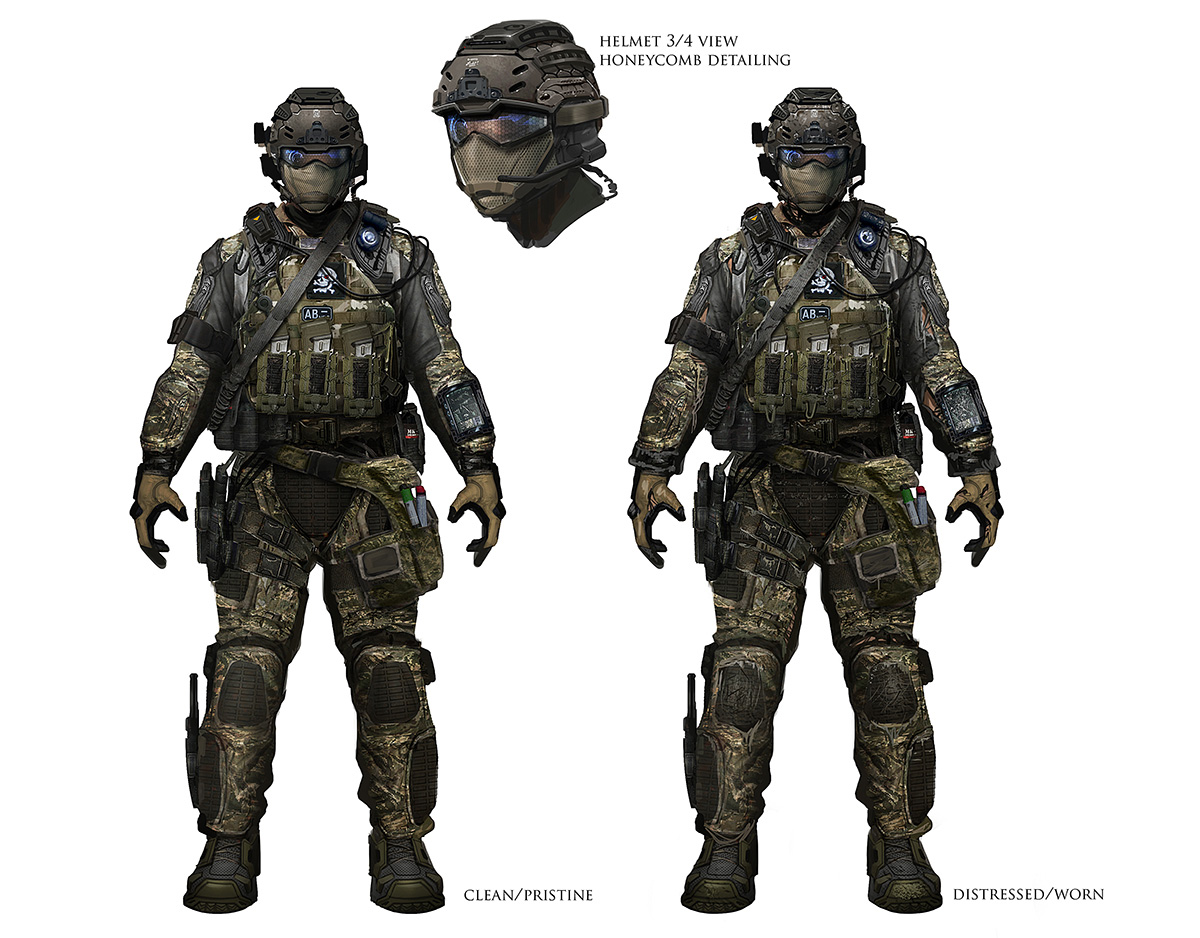
In video games, genre and target audiences is focal to
design, though generally the products are targeted at teenage boys. Often (mostly in first person shooter games) the main character is designed with more generic qualities in order for the player to project themselves in the role and thus fully immerse themselves in the gaming experience.

COMIC BOOK/GRAPHIC NOVEL:
Just as designs for live performances and cartoons, the colour
scheme and definitive shapes are key, so that artists something distinctive to reproduce. This way no matter the art style the new comic book artist has, the characters would be clearly recognizable to the readers. It is particularly interesting that in this case more than any other, the piece of concept art is essentially the final product.The image below is the most recent Superman redesign. The design clearly represents the that particular character since all his distinctive features are there – the colour, chest symbol, the cape and the pose. While more dated elements like the 'Victorian strongman suit' is removed:
Animation
generally simplifies and exaggerates shapes and motion, thus giving more of an impression of them. Character qualities can be translated as form and colour so that young audiences can instantly associate their roles in the story. A perfect example is this character image from Dexter's Laboratory. The basic knowledge necessary to understand the characters and their relationship is all visible through the contrast of colours and accessories.
Dexter and Deedee [2]
Although complete realism in animation tends to be avoided since it is believed it can be uncomfortable for audiences ( 'the uncanny valley'), animated character designs can be much more sophisticated than the example above. This character sketch for Tangled is clearly a more literal anatomical representation, while still being quite stylized. The facial expression and posture clearly suggest the overconfident nature of the character.


Alain Hranitelj’s characters
for Cirque du Soleil’s Zarkana [4]
 [7] Superman , DC
COMPREHENSIVE DEMONSTRATION:
In response to the statements above I demonstrate my ability to accurately apply genre-appropriate techniques through my work on the Gang Members for the Excelsior brief.
The image below is a variation of a thief character design for a video game. The tools and the direction of the light-source suggest that they are antagonists, though the use of the one-shoulder-cape and the straight confident posture on the third figure are traits to heroic characters.

Character design variation:
Having that pointed out definitely took part in the choice of the middle design for the final image. I applied the design aspects that worked well on that variation image into the making of the rest of the members of the gang. They all have concealed faces and suspicious looks. And they are all illuminated from behind, suggesting the thrive in the shadows:
 Group Character Design:
In response to the statements above I demonstrate my ability to accurately apply genre-appropriate techniques through my work on the Gang Members for the Excelsior brief.
The image below is a variation of a thief character design for a video game. The tools and the direction of the light-source suggest that they are antagonists, though the use of the one-shoulder-cape and the straight confident posture on the third figure are traits to heroic characters.
Character design variation:
Having that pointed out definitely took part in the choice of the middle design for the final image. I applied the design aspects that worked well on that variation image into the making of the rest of the members of the gang. They all have concealed faces and suspicious looks. And they are all illuminated from behind, suggesting the thrive in the shadows:
Group Character Design:



No comments:
Post a Comment